Subscribe: pinterest
Showing posts with label Friday letter. Show all posts

Friday, June 7, 2013

Just a Skype Call Away

Skype-icon
Over the course of the year, I have shared with you a variety of sounds that have been heard in the hallways and classrooms of Schechter. Last week, our Upper School lobby was the site of a new sound. Listen to it here.


Recognize it? It is the sound of an incoming Skype call. Student Life Director Mike Hirsch has brought a netbook and wireless modem on the senior class trip to Israel. Each time we  hear that noise, whoever is in the hallway gathers around one of the LCD screens in the lobby to check in on the latest news of the trip.


Through our digital connection to the seniors, we have been treated to beautiful scenes of Israel and tasted the seniors’ enthusiasm for this incredible culminating experience of their Schechter education. Their excitement has been a welcome break from the serious atmosphere that surrounds finals and Regents’ exams as we move closer toward the end of the school year.


For many of our students, this trip seems like such a far away activity for them. Having our seniors, along with their chaperones - Rabbi Rabin, Mrs. Hiltzik, and Mike Hirsch, on the screen, we bring this closing Schechter experience a little closer and whet the appetites of our 6th through 11th graders just a little bit more for a trip that will be the experience of a lifetime.


So, we continue to look forward for each time that we hear the sound of a Skype call coming in and wish our seniors a continued nesiyah tova - a safe and enjoyable trip.

Friday, May 10, 2013

A Staircase to...?


Tuesday started off with an unusual request. On my way to run one of the high school’s alternative minyanim, I was stopped by a group of seniors on the staircase. “Dr. Yares,” they asked, “Can we have our grade level minyan today?”

Now, these same students have been involved in the tefillah conversations that had happened earlier in the year with the Student Government and later with the Va’ad Tefillah. Naturally, I was a bit surprised to hear them request to not have the alternative minyanim that they had helped bring about. However, when they shared their reason for their request, then I got it.

What was the reason? “It’s our last tefillah together as a grade.”

This was a profound statement from these students. While the alternative minyanim are designed to help provide tools to draw us closer to God through tefillah, the students were reflecting on another purpose of tefillah, drawing us closer to each other.

Jewish prayer can happen as an individual, but when we gather as a group of ten or more, as a minyan, we gain the ability to say special tefillot. More importantly, perhaps, is that tefillah in a minyan includes portions that are said aloud and this format emphasizes the community that we are trying to build.

How do we know that our seniors understood this? Perhaps through the request or perhaps it was through the most spirited Aleinu that the school has ever heard. Stomping, dancing, and singing with ruach accompanied this final prayer of their final in-school minyan of their senior year. The kavanah (intent) of their tefillah came through strongly and intensely.

Sometimes when we pray, we connect with God. Sometimes, we connect with each other. And sometimes, we get to do both.

Friday, May 3, 2013

Goats and Lemons


Here is an interesting question to begin your Shabbat with. What do goats and lemons have in common? On the surface, not much. One is an animal and the other is a fruit, but somehow they both send the same powerful message.

Two weeks ago, we read the double parashah of Achrei Mot-Kedoshim in shul. In it, we read about how the Kohain Gadol (High Priest) takes two goats, sacrifices one, and bestows the sins of the people on the other. This is the origin of the scapegoat. It’s literally the goat that gets to escape (of course, later texts indicated that the goat was thrown off the side of a cliff during the time of the Temple - just to make sure that our sins didn’t wander back into town).

Which goat gets the better deal? The one sacrificed immediately or the one blamed with the sins of an entire nation? As Jews, we are acutely aware of the pain that scapegoating can bring. Blaming others for your own problems may seem like an easy course, but it is not a healthy course and means denying your own role in the problem.

This brings us to the lemons that were found in this week’s 6th grade Advisory. Dr. Limor Tintweiss, our BOCES school psychologist, joined Advisory teachers Esther Dubow and Jaime Pitschi and brought along a bag of lemons. This was not be a lesson on how to make lemonade out of these lemons, but rather a plan to get our students to think about the stereotypes that they have and strengthen their understanding of the need for tolerance.

Dr. Tintweiss shared pictures of individuals with the class and asked them to share their assumptions. Our students drew a wide variety of conclusions from the photographs, without necessarily knowing anything more about the person in the picture. Then, Dr. Tintweiss handed a lemon to each group of students. The students studied their lemon and got to know its nuances. Then, their lemon was plunked down amidst several other lemons and students had to pick out which one was there’s. Surprisingly, our students knew their lemons and picked them out with a 100% success rate.

In the discussion that followed, students talked about how they had to recall the individual features of their lemons and see how it stood on its own. Prior to this, students had never really thought about the differences that individual lemons have and considered them to just be part of a broader class. The conversation turned to how we make generalizations about groups of people based upon limited knowledge and understanding. When we make these stereotypes, we open the door to scapegoating others.

In our complex and diverse society, it is increasingly important that we bring tolerance and understanding with us in our interactions. Too often, we will be offered the opportunity to blame the other rather than seek to understand them and grow from this understanding. Seeing the individual, whether it is a goat, a lemon, or a person is the key. The conversations about tolerance and stereotyping in the 6th grade Advisory class are just one part of making this a more just and civil society.

Friday, April 26, 2013

Beginning to Blend


To say that today’s adolescents have a fascination with social media and communication might be an understatement. According to webwisekids.org, 73% of teens have a social media account. Once they go on a social media site, the website found that students do the following:
        86% of social network-using teens comment on a friend's wall
        83% comment on friends' pictures
        66% send private messages to friends
        58% send IM or text messages using the site
        52% send group messages

Instead of focusing on the problems that these statistics create, I would rather look at the opportunity that they present and how we as educators are beginning to capitalize on them. Our students enjoy the level of interaction that social media sites such as Facebook provide them and willingly engage with each other on them. How then can a school harness these tools to enhance student learning?

Back when I was teaching Rabbinics at Krieger Schechter, I created an assignment where the students were interacting via Pinterest (You can read about that experiment here and here). The potential was there to engage students at a deeper and more meaningful level through a format they wanted to use. For me, this was just an initial foray and I knew that more could be done.

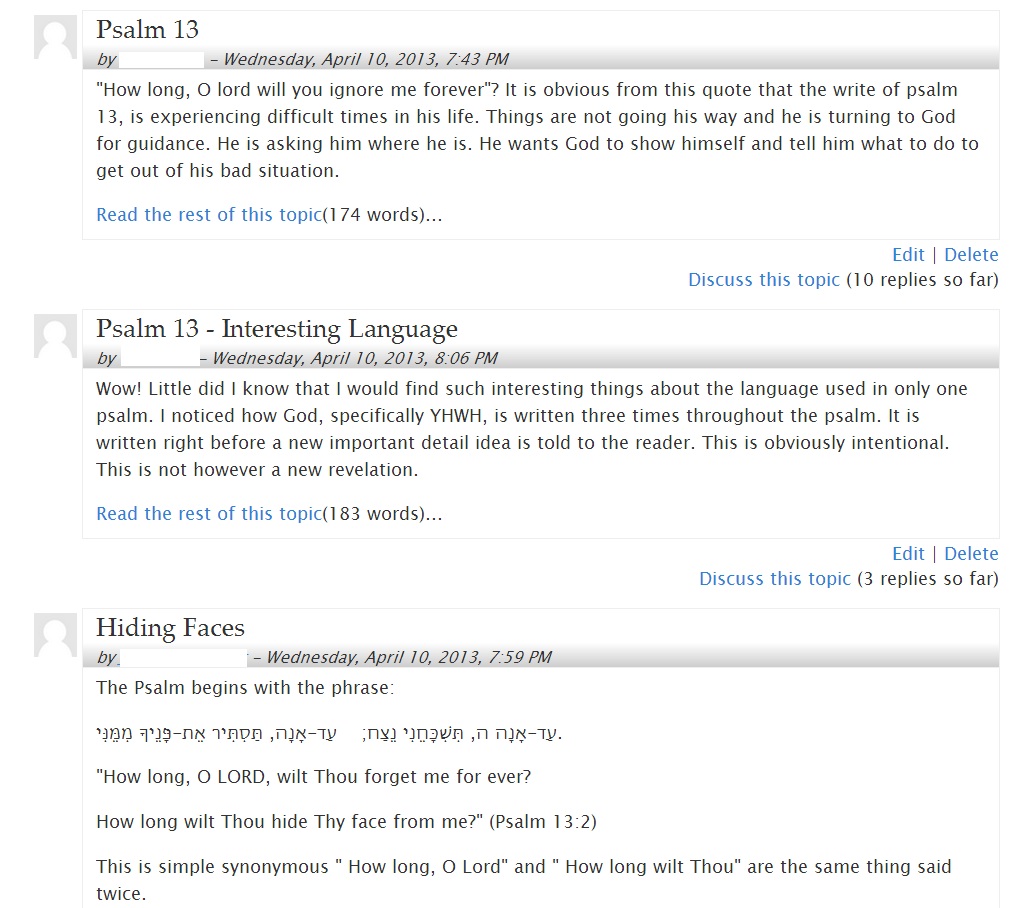
While we have primarily used Moodle this year as a tool for posting assignments, it has the potential to do so much more. 10th grade Tanakh teachers Becky Friedman-Charry and Esther Dubow have created a series of online forums in Moodle where 10th grade students in both sections of the course are extending their classroom conversations about various psalms. In a traditional classroom discussion only a limited number of voices are heard.  In the online discussion each student has the opportunity to share and be heard. Students are encouraged to post regularly and to read and comment on each other’s thoughts. Take a look at just a few of the postings about Psalm 13.


Student engagement in these discussion forums goes beyond their desire to be successful in a graded course.  They’re connecting to each other and they’re connecting to our Jewish tradition.
Social Studies teacher Kelly Delaire is similarly reaching out to her students through social media. As previously reported in Paw Print Now, Ms. Delaire realized that if she wanted her students to be more in touch with current events, she had to reach out to them where they were. On this Facebook page, news articles and essays are being posted that are relevant to her students’ studies and extending the learning outside of the classroom.

Each of these projects is an incredible way to make learning more meaningful and engaging. The assignments and information is interesting and allows the students to interact in a forum that they are comfortable with. They demonstrate our willingness to embrace a trend towards blended learning that combines online and traditional classroom interaction. But, perhaps, most importantly, they create opportunities for students to learn and model the online behaviors that we want them to present as they boldly venture out onto the Internet.

Friday, March 22, 2013

Meditating on Freedom


Early on Wednesday morning, I was working with a group of high school students on a meditation exercise in our alternative minyan. As we meditated together, I realized that the intentional and unintentional activities of the week had somehow aligned as the perfect preparation to spiritually enter Pesah. The meditation exercise that I had picked to use during the Amidah focused on reflecting on feelings of happiness, peace, and freedom. It was during this last portion of the exercise that, for me, the week began to click together and I realized that I was becoming ready to enter z’man matan cherutainu, the time of receiving our freedom.

On Monday, our 8th graders led an interfaith seder for the students of St. Aidan School, our neighbors around the corner. They eloquently explained the reasons behind each section of the seder and served as ambassadors of both our school and the Jewish people. Together, we celebrated the beauty of the seder and learned about its educational mission as the story of the exodus from Egypt is told. For two groups of students from different faiths to sit down and learn from one another brings to mind the incredible gift of our religious freedom.

Tuesday morning began with the delivery of the cots from New York Blood Services for our second blood drive of the school year. Blood, however, has a mixed relationship with Pesah. It can bring to mind the infamous blood libels of our past as Jews were accused of using the blood of Christian children to make matzot. It can also represent the first of the Ten Plagues that dip our fingers into at our seder. At school, however, it represented giving others the gift of life through 48 units of blood that students, staff, parents, and other members of the Schechter community contributed. This giving of ourselves provides others with the freedom to live their lives in health.

Even the fire alarm during high school lunch provided a sense of liberation. Yes, it was cold and wet outside. Yes, it was scary not knowing what was going on. But as an administrator, I found a sense of freedom from my own fears of what would happen if we did have an emergency in the building. Our preparations and practice with our own emergency procedures worked.

With the feeling that spring is actually arriving, our sixth grade students set out to engage in acts of maot chittim, pre-Pesah activities of chesed (community service). While our students did not gather wheat to provide others with the ability to celebrate Pesah, they did stock kosher for Pesah supplies at a food pantry. With the ever present fear of hunger among some in our community, our students worked to liberate them from this through their actions.

I was greeted early one morning by a student stating that she was so tired, but vacation is only a few days away. Clearly, our students are looking forward to the freedom from classwork that Pesah break will bring. Many of us among the faculty have joked about our own self-imposed slavery as we prepare for Pesah and are yearning to be set free.

My hope is that all of us will have a moment to truly reflect on what freedom means to us as we sit down at our own seder tables with friends and family to tell the story of our people’s exodus from Egypt. May you truly be able to feel a sense of freedom as we celebrate z’man matan cherutainu.

L’Shanah Ha’Ba’ah B’Yerushalayim (Next Year in Jerusalem)!

Thursday, February 28, 2013

Powered by Chesed

Like most educators, actually, probably like most people, I dread the day that I return to work after vacation. It’s not that I don’t want to go back to school. As a principal, I truly enjoy what I do. It’s the shift from the routine of vacation to that of work that I find jarring. It is an awkward transition from a (hopefully) more relaxed pace to a more frenetic pace. This week was different. While, of course, there was a portion of me that would have loved to sleep a little later on Monday morning, I was excited to step foot back in the building.

For weeks, the anticipation of our Shushan Purim Chesed Day has been building among the staff. Rabbi Josh Rabin, our Rav Beit Sefer, kept us updated with each contact that he made for the various service projects that would be available for our students. Plans were set for a modified schedule and buses were ordered for the high school projects, while supplies were purchased for the middle school project.

But on Monday morning, it was finally here.

With a group of 9th and 10th graders, I excitedly boarded the bus to AHRC. We were eagerly greeted and we began to visit and play with a group of autistic preschool and elementary school students. The ice and awkwardness quickly melted as the Schechter students followed their new friends from station to station in a physical education activity in the AHRC gym. Everyone was smiling, laughing, and enjoying themselves.

Perhaps the most touching aspect of the experience was the reluctance of our students to leave AHRC. They had seen first hand how they could touch someone else’s life and, perhaps, this is the real purpose of giving matanot l’evyonim (gifts to the poor). Our students connected with people who they could have seen as the “other,” but instead saw them as fellow human beings.

This single event has kept me powered for an entire week.

While we work to plan other opportunities for our students to engage in tikkun olam, we encourage you to reach out to these agencies or others that we worked with and encourage your child to make volunteering part of their lives. As a school, we have a community service/hesed requirement because we strongly believe that tikkun olam needs to be an integral part of our lives as Jews and we lay the groundwork for what we hope will be lifelong habits here at Schechter.

Sunday, January 27, 2013

Friday Letter - January 25, 2013

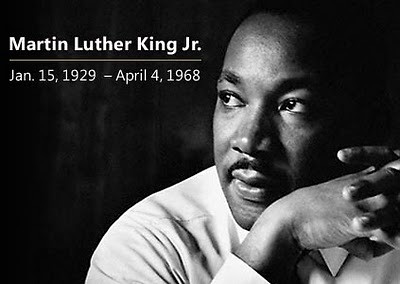
The legacy of Dr. Martin Luther King, Jr. was on the minds of students and staff alike in the Upper School as we began this week.

Students in the Middle School spent time reflecting on the accomplishments of Martin Luther King and the reasons we set aside this day to honor him.  After completing a short assignment researching who he was and what his goals were, students were able to have a meaningful discussion, guided by Middle School Social Studies teacher Jaime Pitschi, focusing on the idea of tolerance, about the impact Dr. King has had on the United States and on their own lives.  Taking this knowledge, students traced their own footprints in an effort to show how they can, as Rabbi Abraham Joshua Heschel is often quoted, “pray with their feet.”  On their left foot, they were to write and/or draw one way Dr. King’s message of tolerance has affected their lives today, while on the right foot they were to write and/or draw one thing they would do to continue Dr. King’s message of tolerance.  The 6th, 7th and 8th grade students were very thoughtful in their approach to the assignment and created beautiful footprints that reflect their interpretation of Dr. King’s message.

Through the work of Rabbi Iscah Waldman and Social Studies Department Coordinator Randy Trupin, high school students explored the famous “I Have a Dream” speech of Dr. Martin Luther King, Jr. First students viewed a video of the speech, then with the help of faculty members and seniors in Rabbi Waldman’s Rabbinics class, students explored the text of the speech, making connections to important Jewish texts through a school-wide beit midrash (literally house of study) in the gym. This was an incredible learning experience for students combing Jewish and general studies through the lens of a classic Jewish learning technique, the beit midrash.

Students in both divisions left the day with a stronger sense of why we choose to honor  Dr. King each January and, hopefully, with some thoughts on how we can honor and build upon his life’s work throughout the year.

Friday, January 18, 2013

Friday Letter - January 18, 2013

Wednesday around lunchtime, students and some faculty were a bit perplexed by the noises emanating from the lobby of the Upper School. At times, it seemed melodic and would resonate down the hall in a pleasing manner. What could the noise possibly be? Cautiously, the students and staff peered around the corner or stepped out of their offices to see what was going on.

Huddled around a electronic keyboard with Joan Freeman Cohen at the keys, were four members of our staff, Barbara Mann, Becky Friedman-Charry, Mike Bourdet, and myself. Furiously studying sheet music for several songs, this small group was launching the first Schechter School of Long Island Guerilla Choir.

What is a Guerrilla Choir? Think of it as a musical flash mob - several people gathering together for the expressed purpose of singing a little bit. No prior rehearsals, just some sight singing with a little piano help to make sure that we stayed in the same key.

Of course, being a group of singing educators, we did have an ulterior motive which was to pique the interest of Schechter students and staff in exploring organized vocal music. In other words, you can sing in places other than the shower. Already students have been approaching us and asking, “What was that for?”

The Guerilla Choir will strike again in a few weeks during lunch on Feb. 4. If you are in the building, join us and hum along for a few bars.

Shabbat Shalom!

Monday, January 14, 2013

Friday Letter - January 11, 2013

It has been more than a week since we returned from winter vacation and, because so much goes on at the Upper School,  it seems like the distant past. Opportunities continue to abound here at the Schechter School of Long Island for students to engage their curiosity and to grow as individuals as we plan and participate in upcoming special events and programs.

With the American elections behind us, the school turned its focus to the upcoming Israeli elections. Discussions began in Hebrew classes as students began to learn about the Israeli elections. Given the complexities and differences from American politics, it was clear that students needed an in-depth briefing to help them negotiate the Israeli political landscape. Which parties advocated for which issues? What does it mean to be on the right or the left in Israel? And how exactly is the government formed when there is no direct election of the prime minister?

Enter Kenneth Bob, chair of the American Zionist Movement, president of Ameinu, and SSLI alumni parent. In his talk with students, Mr. Bob sketched out the roots of Israeli politics and connected formative Israeli leaders such as Menachem Begin and David Ben-Gurion to their political affiliations, helping the students contextualize their understanding of Israeli history with its politics. He then moved on to outline the current political landscape, describing the parties standing for election to the Knesset. Students left with a clearer understanding of the complexities of Israeli politics and basis for understanding the Israeli election news that we will read over the next several weeks.

On separate front, auditions and casting are complete for the high school’s spring musical, The Drowsy Chaperone. Thank you to the faculty who assisted Joan Freedman Cohen in the audition process. Excitement is already building for this new production and we look forward to the cast taking the stage for the 10th anniversary performance of the Schechter spring musical at the Long Island Children’s Museum on March 7, 9 and 10

It has been a great start to the new year.

Shabbat Shalom!

Friday, December 21, 2012

Friday Letter - December 21, 2012

I like a good argument. There’s something about engaging in a passionate conversation about a topic that gets the adrenaline flowing. Now, I’m not suggesting that we run around picking fights with each other. A healthy argument includes respect for one’s opponent and a conversation that stays focused on the issues rather than on the ad hominem attacks that we see among some talking heads on TV. This kind of debate is a great tool in and out of the classroom as it allows students to see an issue from multiple perspectives and forces them to back up an opinion with reasoning and facts.

This week in the AP Government class, there were timely debates regarding the role of interest groups in our political system. Specifically, the role of the NRA was part of the debate.  Several AP Government students made solid contributions on this subject.


On Tuesday, Robin Stanton's English 10 Honors class participated in two debates.  Students spent the previous two weeks working in teams: researching and synthesizing source material, planning strategy, and polishing their presentations.  On the morning of the debate, students arrived in professional attire.  They presented their arguments with a poise and authority that belied their years. Debate results were released later that day on PawPrint Now.


The members of the Debate Club are learning how to present persuasive arguments in support of or in opposition to current controversial topics that have been in the news frequently. It has also been discussed that you do not have to personally agree with the side of an issue that you are presenting. An effective debater should know both sides of an issue. Some of the topics that have been or will be the focus of our debates are listed below.


  1. Which presidential candidate should be the next president of the United States?
  2. Are social network sites such as Facebook, Twitter, MySpace, or LinkedIn good for our society?
  3. Do video games contribute to youth violence?
  4. Do the movies produced in Hollywood have a bad influence on society?
  5. Should athletes be allowed to use enhancement drugs?
  6. Should medical marijuana be available in all states?

During each meeting of the club, two teams are selected to take different sides of an issue. Each team presents their arguments. Each team has an opportunity to a rebuttal of the opposing teams statements. Then each team gives a very quick summary of their  arguments. The team that gives the best presentation is declared the winner by the club adviser, Mr. Steger.


The high school student government has also been involved in a debate of substance, among themselves and with the faculty. In response to some planned changes to 10th and 11th grade minyanim, student leaders wrote a letter to administration expressing their concerns. Several meetings have been held to discuss both student and faculty concerns and a partnership is developing out of these passionate arguments about how to engage our students in tefillah. As they develop, I look forward to sharing with you our plans.


There is no argument that it is time for winter vacation. On behalf of the faculty and staff of the Upper School, I wish you an enjoyable and safe winter vacation.


Shabbat Shalom!

Thursday, December 13, 2012

Friday Letter - December 14, 2012

For the last several weeks, it has been dark when I have left for school in the morning and dark again when I have arrived at home. With the winter solstice approaching, we will soon see increasing daylight hours, but until then, I find myself craving the light. Perhaps it is fitting then that the Festival of Lights arrives in the midst of this darkness imposed by the Earth’s axis and its rotation around the sun.

Fortunately, there has been plenty of (high)lights to go around this week. Saturday night brought with it the first night of Hanukkah and the closing performance of Shlemiel the First. This group of talented high school actors shown on the stage as they made the audience laugh until we cried with the antics of the residents of Chelm. The “wisdom” of the Chelmites defied logic and the performance amazed and delighted. Kol HaKavod to Joan Freedman Cohen and the cast and crew!

The days brightened some more with our Hanukkah Haggigah (holiday celebration). Middle school and high school students thoroughly enjoyed the rhymes, rhythms, and music of Bible Raps performer Matt Barr. Students (and Rabbi Bernstein and Rabbi Josh) joined in on stage for portions of the performance as they used this medium to explore the holiday and their connection to Judaism.

Glow sticks, strobe lights, and candle light pierced the darkness during the middle school dance. In addition to our own students, we were joined by students from Solomon Schechter Day School of Queens and East Midwood Hebrew Day School. This was a wonderful opportunity to bring students together from the schools within the Schechter Network. We closed the night with a communal candle lighting and the singing of Maoz Tzur.

There is a Talmudic argument between the houses of Hillel and Shammai over how candles should be lit during Hanukkah. Shammai’s disciples promoted starting with all eight candles lit and reducing the number of candles each day while Hillel’s students thought that we should should increase the candles until all eight were burning the last night. While everyone knows which school of thought we follow on this issue, it is clear to me that, at least this Hanukkah, we have seen the light increase as we have moved through the holiday.

Shabbat Shalom v’Chag Urim Same’ach!

Friday, December 7, 2012

Friday Letter - December 7, 2012

Metal menorahWhen asked about the origin and meaning behind the holiday of Hanukkah, most people will reflect on either the victory of the Maccabees over the Syrian-Greeks or the miracle of the oil lasting for eight days. Setting aside that the story of the miracle may have been a fabrication of the Rabbis to downplay the military victory, both of these origin stories only briefly touch on the reason for the name of the holiday.

Hanukkah means dedication. In the case of the holiday, it was more of a re-dedication, as the Maccabees purified the Temple in Jerusalem to make it fit for worship following its desecration by the forces of Antiochus. The military victory occurred to allow the Maccabees to liberate the Temple and the story of the oil stems from the lighting of Temple’s menorah as part of the re-dedication efforts.

It’s fitting then that our school calendar at this time of year brings with it several opportunities for our students to also engage in re-dedication to their academic studies. Report cards have been issued in the high school and were mailed today in the middle school. Parent conferences kicked off this week with the first round of high school conferences and will continue over the next two weeks for both divisions.

Report cards and conferences offer an opportunity for parents and students to have conversations about student learning. Students can take stock of their efforts and see where they need to make adjustments or change strategies. They can feel reinforced that their hard work is paying off or realize that they need to reach out for the many supports available at school.

So, this Hanukkah, rather than starting planning for your New Year’s resolutions and what new things you want to do, think about what you want to re-dedicate yourself to.

Shabbat Shalom v’Chag Urim Same’ach!

Friday, November 30, 2012

Friday Letter - November 30, 2012

One of my first introductions to life at the Upper School was a phenomenon known as being “Paw Printed.” Thinking back, I’m not sure if I had even stepped foot on the campus as the incoming Upper School Principal when I received an e-mail from a student-reporter asking to interview me for the high school newspaper, Paw Print. We e-mailed back and forth a few times and made arrangements to speak at my next visit. She asked me a variety of questions about my reasons for coming to the Schechter School of Long Island, my background, and my thoughts on education. In other words, I was “Paw Printed.”

Since then, I’ve been “Paw Printed” several more times, and I am sure that there will be more.
In the past week, I’ve been approached by student-reporters from each of the school’s news publications, Paw Print, Paw Print Now, and News from the Middle, the middle school paper.  Our student reporters are diligent, inquisitive, and respectful when they are out “on the beat.” And, as I learned from my first experience with Paw Print, persistent.

Student journalism is an incredible learning experience for our students. With the support of Paw Print and Paw Print Now advisor, high school English teacher Shawn Thorgersen, and News from the Middle advisor, middle school English teacher, Kayla Motroni, students have been organizing coverage of school events and thinking about issues of concern to students with the goal of creating a quality publication that engages its readers. Students, particularly our reporters for the Paw Print Now daily news blog, are learning about deadlines and figuring out what is actually newsworthy. And, of course, they are learning about writing as a journalist.

So, the next time that you are in the building for a program, don’t be surprised to be approached by a student with some probing questions about life at Schechter. After all, you could be the next person to be “Paw Printed.”

Shabbat Shalom!

Wednesday, November 21, 2012

Friday Letter - November 21, 2012

Each year that I have taken groups to Israel, we encourage the students to experience the trip through all of their chumshim (senses): sight, taste, touch, smell, and hearing. As we walk the land, we want them to experience the trip at this basic level and then begin to process the more complex thoughts and emotions churned up by a trip to Israel.

This week, I’ve been thinking a lot about using my senses as I’ve walked the halls of the Upper School. Close your eyes for just a moment and concentrate with me as I walk you through my sensory experience at school.

Touch - The feel of a diligently built bridge being taken apart in Sci-Tech to figure out why it failed. It is just as important to understand why something did not work as it is to get it working as these students learn the principles of engineering.

Taste - We shared cookies, donuts, and juice with our neighbors at St. Aidan’s at our second annual Thanksgiving celebration. We gathered the middle schools of both institutions together for an opportunity to reflect and appreciate all that we are thankful for this holiday. Students heard Father Kevin and Rabbi Josh talk about the things that they have taken for granted and now realize how important they are. Mrs. Joan Friedman Cohen organized a group of 6th and 7th graders on drums and recorders to teach the students a song and the St. Aidan’s choir performed.

Sight - The image of a coalition of Muslim and Jewish schools, synagogues and mosques
gathering together  at Hempstead Town Hall to present Hempstead Town Supervisor Kate Murray with blankets, warm coats and non-perishable food items that they have collected to donate to Hurricane Sandy victims. These items will be distributed by the Town of Hempstead to families in hard-hit communities throughout the Town, whose lives have been devastated by Hurricane Sandy, and many of whom are still unable to return to their homes.       

Hearing - Take an audio tour of many of the classes and other experiences that the Upper School students have had through Sounds of Schechter.

Of course, I have not left off the important sense of smell. Naturally, this week brings with it the smell of turkey roasting in the oven and all of the delicious smells of Thanksgiving. In these post-Sandy days, we have heightened our sense of gratitude towards our blessings. Take a look at what the 10th grade minyan thought about gratitude through the bracha מודים אנחנו לך in the עמידה. Here is a visual representation of their responses.

I wish you and your families a Happy Thanksgiving.

Shabbat Shalom!

Monday, November 19, 2012

Friday Letter - November 16, 2012

One of the joys of my being a school administrator is to get to observe incredible teaching and learning experiences that take place throughout the school day. Most often these experiences occur in the classroom, and this week was no exception. As I wandered from classroom to classroom, I saw students thinking hard about complex subjects and teachers passionately pushing students to challenge themselves just a little bit more.

In 8th grade Spanish, students were melding their knowledge of colors and clothes to describe themselves, their classmates, and the occasional celebrity. 10th grade geometry students carefully thought through the process of developing a proof based upon the postulates they had just learned. Peer editing and coaching from teachers guided the writing process in several classes as students sought to hone their writing skills. Bridges were being built, tested, and redesigned as Sci-Tech students brought design principles and their understanding of physics and materials together to build bridges out of paper and toothpicks.

Of course, not all of this learning took place inside the classrooms. In a meeting this week, our High School Student Government tackled the problem of cafeteria cleanliness by developing strategies to help ensure that our cafeteria and hallways remain clean after lunches are over. Elsewhere, Paw Print reporters and editors worked to prepare the next issue of our high school paper for publication. Middle Schoolers saw their signed “Roaring to Respect” posters placed throughout the building as a reminder that, in every setting of our school, we need to demonstrate respect for self, others, property, and learning.

This week, the students of the Upper School weren't the only ones learning in our building. It began with a community group gathering to study with staff from the Jewish Theological Seminary on Tuesday. This JTS Kollot group will be convening on our campus once a month, and we are delighted to host them.

Another group from outside the Upper School wandered into the building on Wednesday, and suddenly the halls seemed a bit more crowded than usual. The reason? The entire fifth grade had come to the Upper School for the kick-off of their transition to 6th grade. A well-organized scavenger hunt had teams of 5th and 7th graders roaming the building looking for clues and solving problems presented to them by Upper School staff members. For our next class of 6th graders, it was a first real look at the Williston Park campus as their next school. Our thanks to Sandi Swerdloff, the teachers, and the 7th grade for helping make this event possible.

With their parents in tow, the fifth graders once again visited in the evening for the Middle School Open House. While the fifth graders learned even more about the school from Student Activities Director Mike Hirsch, Athletic Director Kerry Dalton, Guidance Counselor Bonnie Cahn, and Rabbi Josh Rabin, the parents settled in for three different presentations from the Middle School faculty which covered many aspects of our curriculum. Thank you to Ms. Polen, Mr. Clarke, Ms. Stanton, Ms. Dubow, and Ms. Hiltzik for guiding the fifth grade parents through the many touchstones of the Middle School curriculum.

The truly amazing portion of the evening came as several of our 8th graders joined a panel of school staff and 8th grade parent, Robin Bensignor, for a question and answer panel. Without blinking an eye, our students fielded questions from the audience about middle school life and their own experiences. We are very proud of how well they presented themselves and the school.

It has clearly been a delight to be back in school for a full week of learning, teaching, and growing.

Shabbat Shalom!

Friday, November 9, 2012

Friday Letter - November 9, 2012

To say that the last two weeks have been unusual would be an understatement. Widespread power outages, damage from two major storms, and gas shortages are not typical topics of conversation in our Schechter community. With all of these unexpected challenges in front of us, it is amazing how our students are rising to the occasion. Through the efforts of the Kesher Club, the school lobby is filling with donations for those families most severely impacted by the storms and the Student Government coin challenge is well underway with the goal of supporting the SSLI Hurricane Sandy fund.

While it is amazing to watch the resilience of our students as they get back into the swing of things and work to move along in their studies, it is important to know that adolescent resilience is not a bottomless well from which to draw from. On the surface, your child may appear to be holding it together, but underneath this, there may be a feeling of fragility as students crave the regularity of their own routines, the privacy of their own homes, and the sense of being in their own space.

Resilience is defined as the ability for something to return to its original form after being stressed or placed in adverse circumstances. We can build resilience by having a positive attitude and emotions and the ability to express our emotions, even if they are negative. Feeling competent and talented at something also strengthens one’s resilience. Resilience can further be buoyed by being connected to the social networks around you and taking advantage of the supports offered. Our Chesed Committee is here to help whether it is a Shabbat meal or finding you warm shelter and we encourage you to take advantage of the services being offered.

As the school year progresses, we will be looking to support our students’ resilience and foster their ability to not just get back to where they were, but to move forward in their academic, social, cognitive, emotional growth. For more on building your child’s resilience, the National Association of School Psychologists offers this handout.

Of course, another way to deal with the stress of these moments and to boost our resilience is a little humor. Take a listen to our 9th grade music class as they sing The Frankenstorm Blues (music and lyrics by Joan Friedman Cohen and the Class of 2016).

We know that conditions at home for many for studying and doing homework are nowhere near optimal. As the end of the quarter approaches, your children’s teachers are trying to be as sensitive as possible to these circumstances. If your child is struggling or feeling overwhelmed, please contact the individual teacher or Senora Cahn for help in navigating the workload.

Shabbat Shalom!