Subscribe: pinterest
Showing posts with label social media. Show all posts

Friday, April 26, 2013

Beginning to Blend


To say that today’s adolescents have a fascination with social media and communication might be an understatement. According to webwisekids.org, 73% of teens have a social media account. Once they go on a social media site, the website found that students do the following:
        86% of social network-using teens comment on a friend's wall
        83% comment on friends' pictures
        66% send private messages to friends
        58% send IM or text messages using the site
        52% send group messages

Instead of focusing on the problems that these statistics create, I would rather look at the opportunity that they present and how we as educators are beginning to capitalize on them. Our students enjoy the level of interaction that social media sites such as Facebook provide them and willingly engage with each other on them. How then can a school harness these tools to enhance student learning?

Back when I was teaching Rabbinics at Krieger Schechter, I created an assignment where the students were interacting via Pinterest (You can read about that experiment here and here). The potential was there to engage students at a deeper and more meaningful level through a format they wanted to use. For me, this was just an initial foray and I knew that more could be done.
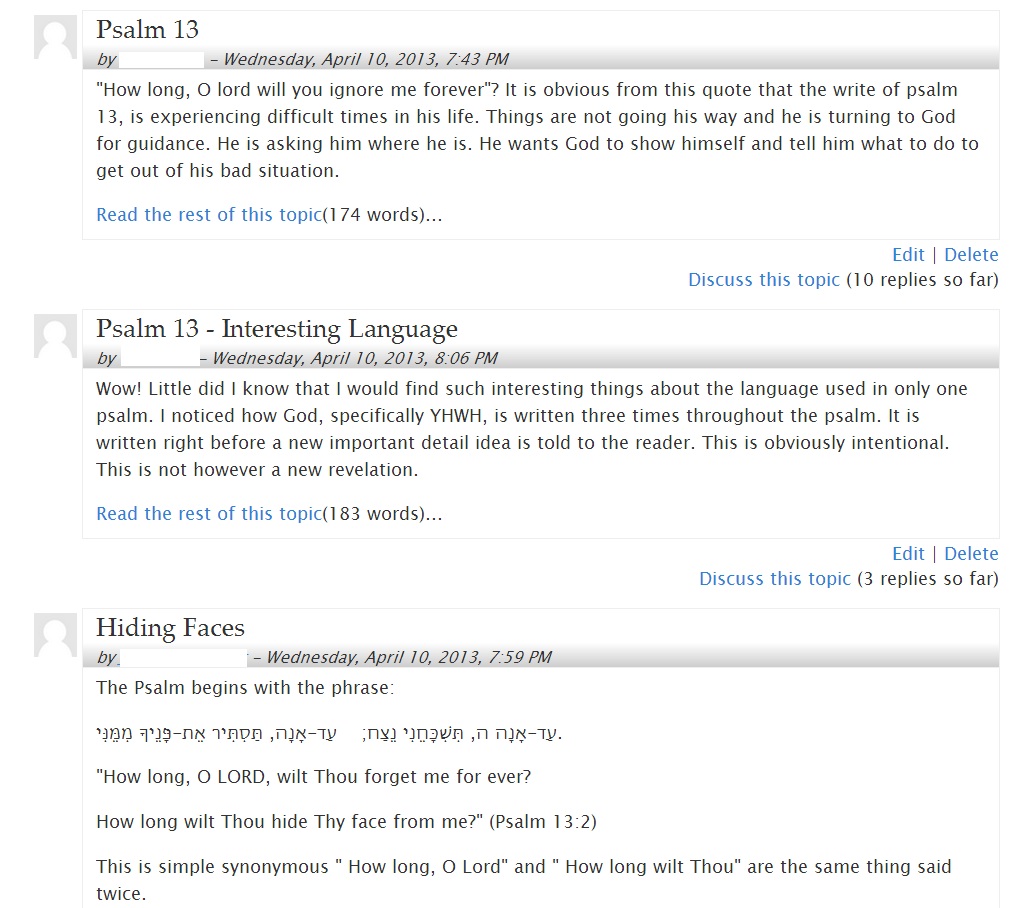
While we have primarily used Moodle this year as a tool for posting assignments, it has the potential to do so much more. 10th grade Tanakh teachers Becky Friedman-Charry and Esther Dubow have created a series of online forums in Moodle where 10th grade students in both sections of the course are extending their classroom conversations about various psalms. In a traditional classroom discussion only a limited number of voices are heard.  In the online discussion each student has the opportunity to share and be heard. Students are encouraged to post regularly and to read and comment on each other’s thoughts. Take a look at just a few of the postings about Psalm 13.


Student engagement in these discussion forums goes beyond their desire to be successful in a graded course.  They’re connecting to each other and they’re connecting to our Jewish tradition.
Social Studies teacher Kelly Delaire is similarly reaching out to her students through social media. As previously reported in Paw Print Now, Ms. Delaire realized that if she wanted her students to be more in touch with current events, she had to reach out to them where they were. On this Facebook page, news articles and essays are being posted that are relevant to her students’ studies and extending the learning outside of the classroom.

Each of these projects is an incredible way to make learning more meaningful and engaging. The assignments and information is interesting and allows the students to interact in a forum that they are comfortable with. They demonstrate our willingness to embrace a trend towards blended learning that combines online and traditional classroom interaction. But, perhaps, most importantly, they create opportunities for students to learn and model the online behaviors that we want them to present as they boldly venture out onto the Internet.

Friday, September 14, 2012

An Intentional Error


In my previous position, one of my roles was providing oversight and guidance for the school's website as it went through a re-design and then serving as the site's administrator once the new site was up. We spent weeks agonizing over the nature of the content and design, often spending significant time guessing how people would experience the site. Not once, though, did we think about the user's experience when the site did not work. In other words, what happens when the user hits one of those lovely web errors?

In his TED talk, Renny Gleeson explains the origin of the 404 error that we have all experienced at one time or another when looking for a specific webpage. I almost didn't watch this talk as my initial glance at the title just didn't inspire me. Something, though, said to watch it anyway and I did. Gleeson describes the family of errors that the 404 Page Not Found error is part. Then, he begins to describe how different startups began taking advantage of these previously lost moments by adding content to their error pages.

Here are some examples.

Gleeson's examples got me thinking about how I would want to change the error pages of my school's website. Should I embed a video or share something about how the school turns its mission into reality? Rather than create a frustrating experience, how can I use this error to connect and build a relationship with the user?

What makes me marvel at this is how intent is added to a seemingly commonplace error message. By placing something meaningful on the 404 page, we tell our users that even when something screws up we're thinking about them. Intentionality is a powerful thing. If we can bring it to bear on a school website, imagine the power it could have inside the school walls.

Sunday, March 18, 2012

Pinterest Project Update

It's been almost a week since I gave out the Pinterest assignment to my 7th grade Rabbinics class. Their reaction to the initial assignment was interesting. Most of them were not aware of the site, but were pretty awed by the basic display of graphics and text that makes up a Pinterest board.

At this point, I've received links to graphics from slightly more than half the class. The "pins" have been from a variety of sources and most strongly relate to the topic. What's been most interesting, though, is that there are other Pinterest users following the board and some of them have "re-pinned" the items on the board.

I'm still trying to decide what the next step will be in this Pinterest experiment. I'm certainly considering using it for other units as I think the challenge of succinctly summing up what a picture means to you is an excellent skill. Furthermore, I think there is value in getting the students to think about a text through a visual media. I'm considering re-using the pictures in the test for this unit, perhaps as a writing prompt.

What's missing, though, is the interactive element that should go hand in hand with a social network. This assignment would be more powerful if I was not serving as the conduit for the students to interact with Pinterest. Given that I'm working with 12 and 13 year old students, I'm not sure that I want to be the person who sets some of them up with their first social networking account.

I'm considering bringing the next version of this assignment into the Google Site that I have successfully used with previous classes.I'm just not sure that it will have the visual flexibility that Pinterest has brought to this project.

Tuesday, March 6, 2012

Testing the Waters with Pinterest


Like many people, I have spent the last several weeks quietly laughing about my wife’s fascination with Pinterest. Very quickly, she has amassed a collection of photographs and web links about a host of topics ranging from recipes to DIY ideas. From a short distance, I was wondering with why we needed one more social media site.

In recent days, I’ve started to undergo a conversion of sorts. I’m not ready to spend hours “pinning” pictures on the site, but am wondering what it can be used for. Ali recently wrote on EdSocialMedia about how Pinterest could be used for schools. Resource collecting made perfect sense to me, as well as a few other uses, but I was wondering if it could be used in the classroom.

With that in mind, I’ve started a little bit of an experiment. Starting next week, I will be teaching a new unit in my 7th grade Rabbinics class that focuses on the concept of “wrongdoing with words.” This is a pretty juicy section of the Mishnah (Bava Metzia 4:10) that compares wrongdoing with words to stealing:
Just as there is wrongdoing in buying and selling, so there is wrongdoing in words. One may not say to him, "How much is this item?" if he does not want to buy it. If he was a penitent, one must not say to him, "Remember your former deeds!" If he was a descendant of converts, one must not say to him, "Remember the deeds of your forefathers!" For it is said, "And a stranger you shall not wrong, nor shall you oppress him" (Exodus 22:20).

I’m looking forward to the discussion that this topic will generate, but I have a new project for my students that I’m hoping will add to our discussions. I’m planning on challenging my students to find images that they connect with our text and email me links to those images (plus a short explanation why). Since I’m just a little concerned about internet safety and since Pinterest's user terms limit it to age 13 and above (as do most social media sites), I’ll do the actual pinning for now. My hope is to create a visual collage that could be part of our end of unit assessment.

I’ve gotten started with a few images here already. You’ll notice that I’ve included some text, too. You can do this by using a tool from PinAQuote that turns text into images.


I’m not sure that Pinterest is the best tool for this task, but I’m going to give it a shot.  In a post,Twyla Felty suggests that Stixty might be a more student friendly tool. I’m thinking about giving it a try, too.
I’ll report back in a few weeks how this experiment works out. And, if you find images that connect to this topic, pass them along.