Subscribe: pinterest
Showing posts with label Schechter School of Long Island. Show all posts

Friday, June 7, 2013

Just a Skype Call Away

Skype-icon
Over the course of the year, I have shared with you a variety of sounds that have been heard in the hallways and classrooms of Schechter. Last week, our Upper School lobby was the site of a new sound. Listen to it here.


Recognize it? It is the sound of an incoming Skype call. Student Life Director Mike Hirsch has brought a netbook and wireless modem on the senior class trip to Israel. Each time we  hear that noise, whoever is in the hallway gathers around one of the LCD screens in the lobby to check in on the latest news of the trip.


Through our digital connection to the seniors, we have been treated to beautiful scenes of Israel and tasted the seniors’ enthusiasm for this incredible culminating experience of their Schechter education. Their excitement has been a welcome break from the serious atmosphere that surrounds finals and Regents’ exams as we move closer toward the end of the school year.


For many of our students, this trip seems like such a far away activity for them. Having our seniors, along with their chaperones - Rabbi Rabin, Mrs. Hiltzik, and Mike Hirsch, on the screen, we bring this closing Schechter experience a little closer and whet the appetites of our 6th through 11th graders just a little bit more for a trip that will be the experience of a lifetime.


So, we continue to look forward for each time that we hear the sound of a Skype call coming in and wish our seniors a continued nesiyah tova - a safe and enjoyable trip.

Friday, May 10, 2013

A Staircase to...?


Tuesday started off with an unusual request. On my way to run one of the high school’s alternative minyanim, I was stopped by a group of seniors on the staircase. “Dr. Yares,” they asked, “Can we have our grade level minyan today?”

Now, these same students have been involved in the tefillah conversations that had happened earlier in the year with the Student Government and later with the Va’ad Tefillah. Naturally, I was a bit surprised to hear them request to not have the alternative minyanim that they had helped bring about. However, when they shared their reason for their request, then I got it.

What was the reason? “It’s our last tefillah together as a grade.”

This was a profound statement from these students. While the alternative minyanim are designed to help provide tools to draw us closer to God through tefillah, the students were reflecting on another purpose of tefillah, drawing us closer to each other.

Jewish prayer can happen as an individual, but when we gather as a group of ten or more, as a minyan, we gain the ability to say special tefillot. More importantly, perhaps, is that tefillah in a minyan includes portions that are said aloud and this format emphasizes the community that we are trying to build.

How do we know that our seniors understood this? Perhaps through the request or perhaps it was through the most spirited Aleinu that the school has ever heard. Stomping, dancing, and singing with ruach accompanied this final prayer of their final in-school minyan of their senior year. The kavanah (intent) of their tefillah came through strongly and intensely.

Sometimes when we pray, we connect with God. Sometimes, we connect with each other. And sometimes, we get to do both.

Friday, May 3, 2013

Goats and Lemons


Here is an interesting question to begin your Shabbat with. What do goats and lemons have in common? On the surface, not much. One is an animal and the other is a fruit, but somehow they both send the same powerful message.

Two weeks ago, we read the double parashah of Achrei Mot-Kedoshim in shul. In it, we read about how the Kohain Gadol (High Priest) takes two goats, sacrifices one, and bestows the sins of the people on the other. This is the origin of the scapegoat. It’s literally the goat that gets to escape (of course, later texts indicated that the goat was thrown off the side of a cliff during the time of the Temple - just to make sure that our sins didn’t wander back into town).

Which goat gets the better deal? The one sacrificed immediately or the one blamed with the sins of an entire nation? As Jews, we are acutely aware of the pain that scapegoating can bring. Blaming others for your own problems may seem like an easy course, but it is not a healthy course and means denying your own role in the problem.

This brings us to the lemons that were found in this week’s 6th grade Advisory. Dr. Limor Tintweiss, our BOCES school psychologist, joined Advisory teachers Esther Dubow and Jaime Pitschi and brought along a bag of lemons. This was not be a lesson on how to make lemonade out of these lemons, but rather a plan to get our students to think about the stereotypes that they have and strengthen their understanding of the need for tolerance.

Dr. Tintweiss shared pictures of individuals with the class and asked them to share their assumptions. Our students drew a wide variety of conclusions from the photographs, without necessarily knowing anything more about the person in the picture. Then, Dr. Tintweiss handed a lemon to each group of students. The students studied their lemon and got to know its nuances. Then, their lemon was plunked down amidst several other lemons and students had to pick out which one was there’s. Surprisingly, our students knew their lemons and picked them out with a 100% success rate.

In the discussion that followed, students talked about how they had to recall the individual features of their lemons and see how it stood on its own. Prior to this, students had never really thought about the differences that individual lemons have and considered them to just be part of a broader class. The conversation turned to how we make generalizations about groups of people based upon limited knowledge and understanding. When we make these stereotypes, we open the door to scapegoating others.

In our complex and diverse society, it is increasingly important that we bring tolerance and understanding with us in our interactions. Too often, we will be offered the opportunity to blame the other rather than seek to understand them and grow from this understanding. Seeing the individual, whether it is a goat, a lemon, or a person is the key. The conversations about tolerance and stereotyping in the 6th grade Advisory class are just one part of making this a more just and civil society.

Friday, April 26, 2013

Beginning to Blend


To say that today’s adolescents have a fascination with social media and communication might be an understatement. According to webwisekids.org, 73% of teens have a social media account. Once they go on a social media site, the website found that students do the following:
●        86% of social network-using teens comment on a friend's wall
●        83% comment on friends' pictures
●        66% send private messages to friends
●        58% send IM or text messages using the site
●        52% send group messages

Instead of focusing on the problems that these statistics create, I would rather look at the opportunity that they present and how we as educators are beginning to capitalize on them. Our students enjoy the level of interaction that social media sites such as Facebook provide them and willingly engage with each other on them. How then can a school harness these tools to enhance student learning?

Back when I was teaching Rabbinics at Krieger Schechter, I created an assignment where the students were interacting via Pinterest (You can read about that experiment here and here). The potential was there to engage students at a deeper and more meaningful level through a format they wanted to use. For me, this was just an initial foray and I knew that more could be done.

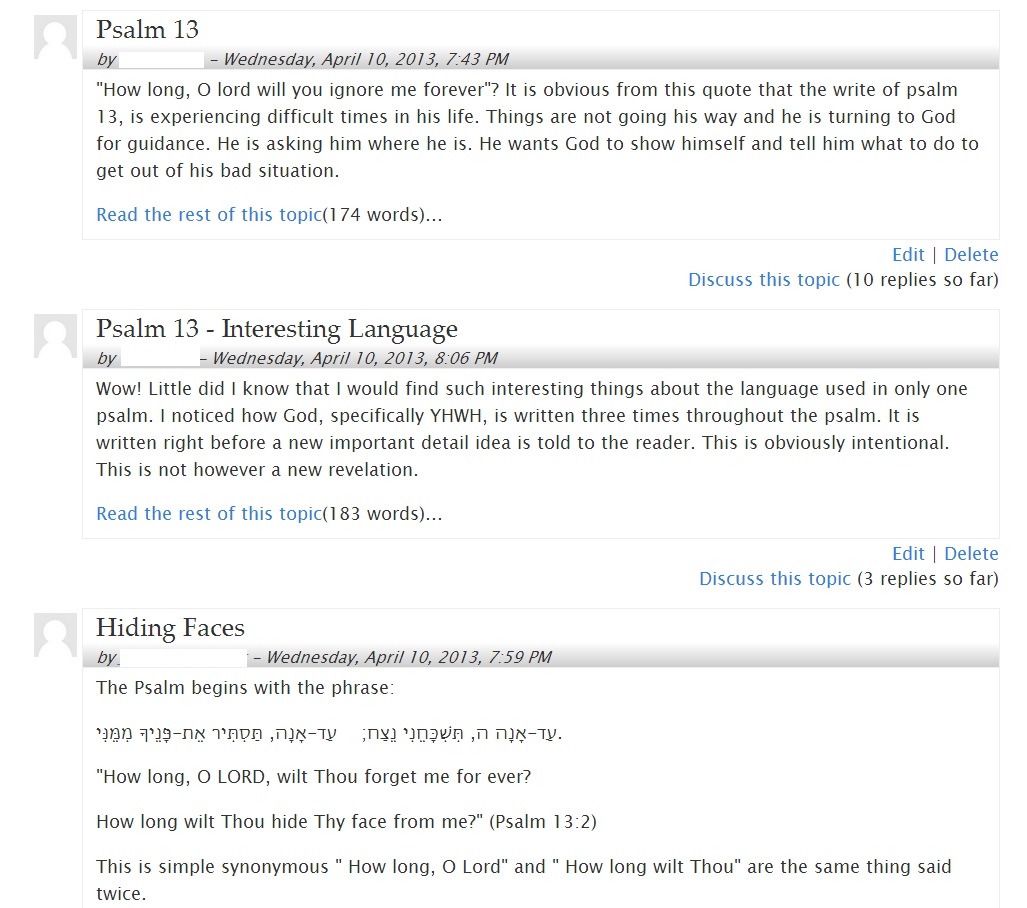
While we have primarily used Moodle this year as a tool for posting assignments, it has the potential to do so much more. 10th grade Tanakh teachers Becky Friedman-Charry and Esther Dubow have created a series of online forums in Moodle where 10th grade students in both sections of the course are extending their classroom conversations about various psalms. In a traditional classroom discussion only a limited number of voices are heard.  In the online discussion each student has the opportunity to share and be heard. Students are encouraged to post regularly and to read and comment on each other’s thoughts. Take a look at just a few of the postings about Psalm 13.


Student engagement in these discussion forums goes beyond their desire to be successful in a graded course.  They’re connecting to each other and they’re connecting to our Jewish tradition.
Social Studies teacher Kelly Delaire is similarly reaching out to her students through social media. As previously reported in Paw Print Now, Ms. Delaire realized that if she wanted her students to be more in touch with current events, she had to reach out to them where they were. On this Facebook page, news articles and essays are being posted that are relevant to her students’ studies and extending the learning outside of the classroom.

Each of these projects is an incredible way to make learning more meaningful and engaging. The assignments and information is interesting and allows the students to interact in a forum that they are comfortable with. They demonstrate our willingness to embrace a trend towards blended learning that combines online and traditional classroom interaction. But, perhaps, most importantly, they create opportunities for students to learn and model the online behaviors that we want them to present as they boldly venture out onto the Internet.

Friday, April 19, 2013

The School is Alive with the Sounds of Music...


It has been a week, well slightly more than a week, filled with music. It began last Friday with a walk through the birth of Hatikva by Astrith Baltsan, a renown Israeli concert pianist and scholar. Students were captivated as she told the story of a complex song that reflects the character of the country that it represents. It was an incredible preparation for our return to school this past Monday for Yom HaZikaron and Yom Ha’atzma’ut.

Each of these days was marked by music. On Yom HaZikaron, we sang with mourning and longing in our hearts for those who had given the ultimate sacrifice in defense of the state of Israel. Just as the mood shifted in Israel, so too here did our hearts lighten as we entered Yom Ha’atzma’ut. The senior class marked our celebrations by their incredible performance of the Prince of Egypt, completely in Hebrew. We wrapped up the day with songs of joy and hope.

Here is just a taste of the music that mirrored our emotions as we moved through the week.

Shabbat Shalom!

Friday, April 12, 2013

(Re)Designing Tefillah


A colleague of mine once referred to tefillah as the third rail of Jewish education. As irreverent as this may sound, it stemmed from a deep-seated concern that as Jewish educators we struggle with this area of the day school experience, not because it is not important, but because of its complexity and how hard it is to get it right.

Tefillah is hard. Even as adults we struggle with connecting with God during davening on a Shabbat morning. We try to find the right kavana (intent) to go with our keva (the fixed process of tefillah) and often miss the mark. I can only imagine what our synagogue rabbis are thinking as they stare at us from the bima while we are either grappling with this dilemma or are completely off task. Given how difficult meaningful, engaging tefillah is for adults, it is no wonder that adolescents also struggle with blending kavana and keva together in our daily minyanim.

With this problem in mind, we have begun a series of conversations at school to grapple with this challenge. Our Va’ad Tefillah (prayer committee) is a combined group of students and staff who are actively engaged in seeking solutions to this. The Va’ad Tefillah, with the support of The Jewish Education Project’s Day School Collaboration Network, has been using design thinking to address the often intractable problem of creating meaningful, relevant, and engaging tefillah experiences for our high school students. Through this design thinking process, we immersed ourselves in the situation by looking at it from our students’ points of view. We also sought inspiration from a variety of sources. With this in hand, we began to understand what tefillah experiences meant for them.

We then worked to frame our problem to create “how might we” statements that helped us better define the problems facing us in high school tefillah. We then imagined what could possibly be and collaborated to develop a series of prototypes to help us test our understanding, gain more information, and learn as we continued to work in the cycle of immerse, frame, imagine, and prototype.

Our initial prototypes were a series of alternative minyanim that allowed students to engage with tefillah in a different way. Here are the choices and descriptions that were available to students:

Regular Minyan: Similar to our daily minyanim, this larger group minyan will join together for a spirited davening.
Meditation Shacharit: How do I improve my focus, and organize my thoughts in tefillah?  Come to this Shacharit, where you will learn exciting ways to use meditation a mode of thinking to help you focus and direct your tefillot in new and exciting ways.
Words of Prayer: The siddur is an ancient combination of words from the Tanakh, with additions, adjustments and an overall organization made by our Rabbis through the generations. This minyan will take a close look at different prayers and we'll discuss how each prayer fits into the Rabbis' overall plan for the siddur, and how we can make sense of the siddur – personally -  as 21st century Jews.
Are You There God?: How can we discuss God? Why should we discuss God? What is God? How do we believe in God? (and what does that mean anyway!) This minyan will think about these questions and many other theological issues. Our goal is not to generate answers about God, but rather to startthe conversation about God.
Tech and Tefillah: Can the texts of the tefillot be communicated through modern means? How much of a tefillah would you tweet? We will explore using technology tools, like Twitter, PowerPoint, and Facebook, to help us gain greater understanding of the tefillot in the siddur.

Are these alternative minyanim the solution? Probably not alone, but they are a starting point. These experiences were followed up by a survey as we seek to design a better tefillah experience. Through this process, we hope to shift away from thinking about tefillah as an insurmountable challenge for the Jewish day school experience into one that adds meaning and relevance to all of those who participate.

Friday, March 22, 2013

Meditating on Freedom


Early on Wednesday morning, I was working with a group of high school students on a meditation exercise in our alternative minyan. As we meditated together, I realized that the intentional and unintentional activities of the week had somehow aligned as the perfect preparation to spiritually enter Pesah. The meditation exercise that I had picked to use during the Amidah focused on reflecting on feelings of happiness, peace, and freedom. It was during this last portion of the exercise that, for me, the week began to click together and I realized that I was becoming ready to enter z’man matan cherutainu, the time of receiving our freedom.

On Monday, our 8th graders led an interfaith seder for the students of St. Aidan School, our neighbors around the corner. They eloquently explained the reasons behind each section of the seder and served as ambassadors of both our school and the Jewish people. Together, we celebrated the beauty of the seder and learned about its educational mission as the story of the exodus from Egypt is told. For two groups of students from different faiths to sit down and learn from one another brings to mind the incredible gift of our religious freedom.

Tuesday morning began with the delivery of the cots from New York Blood Services for our second blood drive of the school year. Blood, however, has a mixed relationship with Pesah. It can bring to mind the infamous blood libels of our past as Jews were accused of using the blood of Christian children to make matzot. It can also represent the first of the Ten Plagues that dip our fingers into at our seder. At school, however, it represented giving others the gift of life through 48 units of blood that students, staff, parents, and other members of the Schechter community contributed. This giving of ourselves provides others with the freedom to live their lives in health.

Even the fire alarm during high school lunch provided a sense of liberation. Yes, it was cold and wet outside. Yes, it was scary not knowing what was going on. But as an administrator, I found a sense of freedom from my own fears of what would happen if we did have an emergency in the building. Our preparations and practice with our own emergency procedures worked.

With the feeling that spring is actually arriving, our sixth grade students set out to engage in acts of maot chittim, pre-Pesah activities of chesed (community service). While our students did not gather wheat to provide others with the ability to celebrate Pesah, they did stock kosher for Pesah supplies at a food pantry. With the ever present fear of hunger among some in our community, our students worked to liberate them from this through their actions.

I was greeted early one morning by a student stating that she was so tired, but vacation is only a few days away. Clearly, our students are looking forward to the freedom from classwork that Pesah break will bring. Many of us among the faculty have joked about our own self-imposed slavery as we prepare for Pesah and are yearning to be set free.

My hope is that all of us will have a moment to truly reflect on what freedom means to us as we sit down at our own seder tables with friends and family to tell the story of our people’s exodus from Egypt. May you truly be able to feel a sense of freedom as we celebrate z’man matan cherutainu.

L’Shanah Ha’Ba’ah B’Yerushalayim (Next Year in Jerusalem)!

Thursday, February 28, 2013

Powered by Chesed

Like most educators, actually, probably like most people, I dread the day that I return to work after vacation. It’s not that I don’t want to go back to school. As a principal, I truly enjoy what I do. It’s the shift from the routine of vacation to that of work that I find jarring. It is an awkward transition from a (hopefully) more relaxed pace to a more frenetic pace. This week was different. While, of course, there was a portion of me that would have loved to sleep a little later on Monday morning, I was excited to step foot back in the building.

For weeks, the anticipation of our Shushan Purim Chesed Day has been building among the staff. Rabbi Josh Rabin, our Rav Beit Sefer, kept us updated with each contact that he made for the various service projects that would be available for our students. Plans were set for a modified schedule and buses were ordered for the high school projects, while supplies were purchased for the middle school project.

But on Monday morning, it was finally here.

With a group of 9th and 10th graders, I excitedly boarded the bus to AHRC. We were eagerly greeted and we began to visit and play with a group of autistic preschool and elementary school students. The ice and awkwardness quickly melted as the Schechter students followed their new friends from station to station in a physical education activity in the AHRC gym. Everyone was smiling, laughing, and enjoying themselves.

Perhaps the most touching aspect of the experience was the reluctance of our students to leave AHRC. They had seen first hand how they could touch someone else’s life and, perhaps, this is the real purpose of giving matanot l’evyonim (gifts to the poor). Our students connected with people who they could have seen as the “other,” but instead saw them as fellow human beings.

This single event has kept me powered for an entire week.

While we work to plan other opportunities for our students to engage in tikkun olam, we encourage you to reach out to these agencies or others that we worked with and encourage your child to make volunteering part of their lives. As a school, we have a community service/hesed requirement because we strongly believe that tikkun olam needs to be an integral part of our lives as Jews and we lay the groundwork for what we hope will be lifelong habits here at Schechter.

Thursday, February 14, 2013

Friday Letter - February 15, 2013

RainbowThe room was silent. You could hear a pin drop. It didn't matter that there were more than 150 people seated or standing in the gym. The room could not have been quieter empty. Eyes were facing front. No one was shifting in their seat. The entire focus of the room was towards the podium.

These respectful, dignified reactions were beautiful to watch on Tuesday morning. Our students, regardless of how they personally felt about gay marriage, Judaism and homosexuality, or any related issues, made an incredible statement with their behavior. That statement, as they listened to an alumna tell her story of hiding her identity and gradually coming out, was that each individual is deserving of dignity and respect. It continued as their peers stood in front of them to introduce clips of the movie Hineini: Coming Out in a Jewish High School which depicts the story of a student in a Boston Jewish high school grappling with her sexual identity. As the students moved upstairs into workshops that they had selected earlier in the week, the level of dignity and respect that they afforded each other as they discussed topics that could be potentially fraught with emotion was similarly high.

This is a powerful statement.

I recently saw that this past week had been declared National Random Acts of Kindness week by the Random Acts of Kindness Foundation. What occurred here, in my mind, was much more powerful than a random act of kindness. While we encourage our students to engage the world with derekh eretz and look for moments where they can do tikun olam, there is something even more meaningful when our students actively work as a group to create an environment that provides dignity and respect to everyone. It recognizes that as a community, we are responsible for setting the tone in each and every conversation that we have with another person.

Through our actions and our words, we shape the environment around us. This Tuesday’s program, a product of collaboration between the Tzibur Club and its advisor Becky Friedman-Charry, Robin Stanton, and Rabbi Josh Rabin, laid the foundation for creating an environment that is more accepting of our individual differences. When we return from break, students will have the opportunity to again shape their environment by engaging in acts of tikun olam at our school and in the community for our Upper School Chesed Day. Step by step, we are changing our school and our world.

Friday, February 8, 2013

Friday Letter - February 8, 2013

This week I had the pleasure of attending the North American Jewish Day School Conference in Washington, D.C along with Dr. Dolgin and SSLI Board President Ira Balsam. Over 1,000 people were present representing hundreds of schools. The conference is a collaboration between two of the organizations that our school is a member of, the Schechter Day School Network and Ravsak, along with PEJE, Yeshiva University, and Pardes, the Reform day school association.

One of most encouraging things about attending a conference like this is seeing how vibrant Jewish day school life is and how energized and committed our colleagues are to continuing to grow and innovate within the field. Workshops focused on enhancing our schools through a variety of tools, many of which we have already begun to work with here at the Schechter School of Long Island.

Even more powerful, though, is the ability to engage in conversation with colleagues about the challenges that each of our schools face. Through this dialogue, I gained new insights and ideas into issues like scheduling, tefillah, special programs, and blended and online learning.

The challenge following any professional development opportunity, like any new learning experience, is in applying the knowledge back at home. Over the coming days and weeks, I am looking forward to the individual and collective conversations with our faculty as I partner with them to continue to grow and enhance our school using my experiences at the day school conference as a catalyst.

Sunday, January 27, 2013

Friday Letter - January 25, 2013

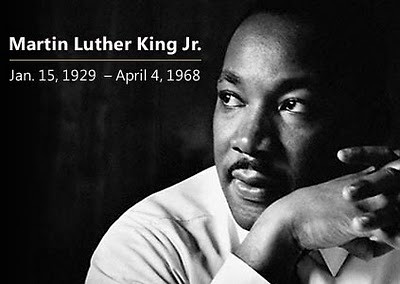
The legacy of Dr. Martin Luther King, Jr. was on the minds of students and staff alike in the Upper School as we began this week.

Students in the Middle School spent time reflecting on the accomplishments of Martin Luther King and the reasons we set aside this day to honor him.  After completing a short assignment researching who he was and what his goals were, students were able to have a meaningful discussion, guided by Middle School Social Studies teacher Jaime Pitschi, focusing on the idea of tolerance, about the impact Dr. King has had on the United States and on their own lives.  Taking this knowledge, students traced their own footprints in an effort to show how they can, as Rabbi Abraham Joshua Heschel is often quoted, “pray with their feet.”  On their left foot, they were to write and/or draw one way Dr. King’s message of tolerance has affected their lives today, while on the right foot they were to write and/or draw one thing they would do to continue Dr. King’s message of tolerance.  The 6th, 7th and 8th grade students were very thoughtful in their approach to the assignment and created beautiful footprints that reflect their interpretation of Dr. King’s message.

Through the work of Rabbi Iscah Waldman and Social Studies Department Coordinator Randy Trupin, high school students explored the famous “I Have a Dream” speech of Dr. Martin Luther King, Jr. First students viewed a video of the speech, then with the help of faculty members and seniors in Rabbi Waldman’s Rabbinics class, students explored the text of the speech, making connections to important Jewish texts through a school-wide beit midrash (literally house of study) in the gym. This was an incredible learning experience for students combing Jewish and general studies through the lens of a classic Jewish learning technique, the beit midrash.

Students in both divisions left the day with a stronger sense of why we choose to honor  Dr. King each January and, hopefully, with some thoughts on how we can honor and build upon his life’s work throughout the year.

Friday, January 18, 2013

Friday Letter - January 18, 2013

Wednesday around lunchtime, students and some faculty were a bit perplexed by the noises emanating from the lobby of the Upper School. At times, it seemed melodic and would resonate down the hall in a pleasing manner. What could the noise possibly be? Cautiously, the students and staff peered around the corner or stepped out of their offices to see what was going on.

Huddled around a electronic keyboard with Joan Freeman Cohen at the keys, were four members of our staff, Barbara Mann, Becky Friedman-Charry, Mike Bourdet, and myself. Furiously studying sheet music for several songs, this small group was launching the first Schechter School of Long Island Guerilla Choir.

What is a Guerrilla Choir? Think of it as a musical flash mob - several people gathering together for the expressed purpose of singing a little bit. No prior rehearsals, just some sight singing with a little piano help to make sure that we stayed in the same key.

Of course, being a group of singing educators, we did have an ulterior motive which was to pique the interest of Schechter students and staff in exploring organized vocal music. In other words, you can sing in places other than the shower. Already students have been approaching us and asking, “What was that for?”

The Guerilla Choir will strike again in a few weeks during lunch on Feb. 4. If you are in the building, join us and hum along for a few bars.

Shabbat Shalom!

Monday, January 14, 2013

Friday Letter - January 11, 2013

It has been more than a week since we returned from winter vacation and, because so much goes on at the Upper School,  it seems like the distant past. Opportunities continue to abound here at the Schechter School of Long Island for students to engage their curiosity and to grow as individuals as we plan and participate in upcoming special events and programs.

With the American elections behind us, the school turned its focus to the upcoming Israeli elections. Discussions began in Hebrew classes as students began to learn about the Israeli elections. Given the complexities and differences from American politics, it was clear that students needed an in-depth briefing to help them negotiate the Israeli political landscape. Which parties advocated for which issues? What does it mean to be on the right or the left in Israel? And how exactly is the government formed when there is no direct election of the prime minister?

Enter Kenneth Bob, chair of the American Zionist Movement, president of Ameinu, and SSLI alumni parent. In his talk with students, Mr. Bob sketched out the roots of Israeli politics and connected formative Israeli leaders such as Menachem Begin and David Ben-Gurion to their political affiliations, helping the students contextualize their understanding of Israeli history with its politics. He then moved on to outline the current political landscape, describing the parties standing for election to the Knesset. Students left with a clearer understanding of the complexities of Israeli politics and basis for understanding the Israeli election news that we will read over the next several weeks.

On separate front, auditions and casting are complete for the high school’s spring musical, The Drowsy Chaperone. Thank you to the faculty who assisted Joan Freedman Cohen in the audition process. Excitement is already building for this new production and we look forward to the cast taking the stage for the 10th anniversary performance of the Schechter spring musical at the Long Island Children’s Museum on March 7, 9 and 10

It has been a great start to the new year.

Shabbat Shalom!

Friday, December 21, 2012

Friday Letter - December 21, 2012

I like a good argument. There’s something about engaging in a passionate conversation about a topic that gets the adrenaline flowing. Now, I’m not suggesting that we run around picking fights with each other. A healthy argument includes respect for one’s opponent and a conversation that stays focused on the issues rather than on the ad hominem attacks that we see among some talking heads on TV. This kind of debate is a great tool in and out of the classroom as it allows students to see an issue from multiple perspectives and forces them to back up an opinion with reasoning and facts.

This week in the AP Government class, there were timely debates regarding the role of interest groups in our political system. Specifically, the role of the NRA was part of the debate.  Several AP Government students made solid contributions on this subject.


On Tuesday, Robin Stanton's English 10 Honors class participated in two debates.  Students spent the previous two weeks working in teams: researching and synthesizing source material, planning strategy, and polishing their presentations.  On the morning of the debate, students arrived in professional attire.  They presented their arguments with a poise and authority that belied their years. Debate results were released later that day on PawPrint Now.


The members of the Debate Club are learning how to present persuasive arguments in support of or in opposition to current controversial topics that have been in the news frequently. It has also been discussed that you do not have to personally agree with the side of an issue that you are presenting. An effective debater should know both sides of an issue. Some of the topics that have been or will be the focus of our debates are listed below.


  1. Which presidential candidate should be the next president of the United States?
  2. Are social network sites such as Facebook, Twitter, MySpace, or LinkedIn good for our society?
  3. Do video games contribute to youth violence?
  4. Do the movies produced in Hollywood have a bad influence on society?
  5. Should athletes be allowed to use enhancement drugs?
  6. Should medical marijuana be available in all states?

During each meeting of the club, two teams are selected to take different sides of an issue. Each team presents their arguments. Each team has an opportunity to a rebuttal of the opposing teams statements. Then each team gives a very quick summary of their  arguments. The team that gives the best presentation is declared the winner by the club adviser, Mr. Steger.


The high school student government has also been involved in a debate of substance, among themselves and with the faculty. In response to some planned changes to 10th and 11th grade minyanim, student leaders wrote a letter to administration expressing their concerns. Several meetings have been held to discuss both student and faculty concerns and a partnership is developing out of these passionate arguments about how to engage our students in tefillah. As they develop, I look forward to sharing with you our plans.


There is no argument that it is time for winter vacation. On behalf of the faculty and staff of the Upper School, I wish you an enjoyable and safe winter vacation.


Shabbat Shalom!

Thursday, December 13, 2012

Friday Letter - December 14, 2012

For the last several weeks, it has been dark when I have left for school in the morning and dark again when I have arrived at home. With the winter solstice approaching, we will soon see increasing daylight hours, but until then, I find myself craving the light. Perhaps it is fitting then that the Festival of Lights arrives in the midst of this darkness imposed by the Earth’s axis and its rotation around the sun.

Fortunately, there has been plenty of (high)lights to go around this week. Saturday night brought with it the first night of Hanukkah and the closing performance of Shlemiel the First. This group of talented high school actors shown on the stage as they made the audience laugh until we cried with the antics of the residents of Chelm. The “wisdom” of the Chelmites defied logic and the performance amazed and delighted. Kol HaKavod to Joan Freedman Cohen and the cast and crew!

The days brightened some more with our Hanukkah Haggigah (holiday celebration). Middle school and high school students thoroughly enjoyed the rhymes, rhythms, and music of Bible Raps performer Matt Barr. Students (and Rabbi Bernstein and Rabbi Josh) joined in on stage for portions of the performance as they used this medium to explore the holiday and their connection to Judaism.

Glow sticks, strobe lights, and candle light pierced the darkness during the middle school dance. In addition to our own students, we were joined by students from Solomon Schechter Day School of Queens and East Midwood Hebrew Day School. This was a wonderful opportunity to bring students together from the schools within the Schechter Network. We closed the night with a communal candle lighting and the singing of Maoz Tzur.

There is a Talmudic argument between the houses of Hillel and Shammai over how candles should be lit during Hanukkah. Shammai’s disciples promoted starting with all eight candles lit and reducing the number of candles each day while Hillel’s students thought that we should should increase the candles until all eight were burning the last night. While everyone knows which school of thought we follow on this issue, it is clear to me that, at least this Hanukkah, we have seen the light increase as we have moved through the holiday.

Shabbat Shalom v’Chag Urim Same’ach!