Subscribe: pinterest

Friday, May 10, 2013

A Staircase to...?


Tuesday started off with an unusual request. On my way to run one of the high school’s alternative minyanim, I was stopped by a group of seniors on the staircase. “Dr. Yares,” they asked, “Can we have our grade level minyan today?”

Now, these same students have been involved in the tefillah conversations that had happened earlier in the year with the Student Government and later with the Va’ad Tefillah. Naturally, I was a bit surprised to hear them request to not have the alternative minyanim that they had helped bring about. However, when they shared their reason for their request, then I got it.

What was the reason? “It’s our last tefillah together as a grade.”

This was a profound statement from these students. While the alternative minyanim are designed to help provide tools to draw us closer to God through tefillah, the students were reflecting on another purpose of tefillah, drawing us closer to each other.

Jewish prayer can happen as an individual, but when we gather as a group of ten or more, as a minyan, we gain the ability to say special tefillot. More importantly, perhaps, is that tefillah in a minyan includes portions that are said aloud and this format emphasizes the community that we are trying to build.

How do we know that our seniors understood this? Perhaps through the request or perhaps it was through the most spirited Aleinu that the school has ever heard. Stomping, dancing, and singing with ruach accompanied this final prayer of their final in-school minyan of their senior year. The kavanah (intent) of their tefillah came through strongly and intensely.

Sometimes when we pray, we connect with God. Sometimes, we connect with each other. And sometimes, we get to do both.

Friday, May 3, 2013

Goats and Lemons


Here is an interesting question to begin your Shabbat with. What do goats and lemons have in common? On the surface, not much. One is an animal and the other is a fruit, but somehow they both send the same powerful message.

Two weeks ago, we read the double parashah of Achrei Mot-Kedoshim in shul. In it, we read about how the Kohain Gadol (High Priest) takes two goats, sacrifices one, and bestows the sins of the people on the other. This is the origin of the scapegoat. It’s literally the goat that gets to escape (of course, later texts indicated that the goat was thrown off the side of a cliff during the time of the Temple - just to make sure that our sins didn’t wander back into town).

Which goat gets the better deal? The one sacrificed immediately or the one blamed with the sins of an entire nation? As Jews, we are acutely aware of the pain that scapegoating can bring. Blaming others for your own problems may seem like an easy course, but it is not a healthy course and means denying your own role in the problem.

This brings us to the lemons that were found in this week’s 6th grade Advisory. Dr. Limor Tintweiss, our BOCES school psychologist, joined Advisory teachers Esther Dubow and Jaime Pitschi and brought along a bag of lemons. This was not be a lesson on how to make lemonade out of these lemons, but rather a plan to get our students to think about the stereotypes that they have and strengthen their understanding of the need for tolerance.

Dr. Tintweiss shared pictures of individuals with the class and asked them to share their assumptions. Our students drew a wide variety of conclusions from the photographs, without necessarily knowing anything more about the person in the picture. Then, Dr. Tintweiss handed a lemon to each group of students. The students studied their lemon and got to know its nuances. Then, their lemon was plunked down amidst several other lemons and students had to pick out which one was there’s. Surprisingly, our students knew their lemons and picked them out with a 100% success rate.

In the discussion that followed, students talked about how they had to recall the individual features of their lemons and see how it stood on its own. Prior to this, students had never really thought about the differences that individual lemons have and considered them to just be part of a broader class. The conversation turned to how we make generalizations about groups of people based upon limited knowledge and understanding. When we make these stereotypes, we open the door to scapegoating others.

In our complex and diverse society, it is increasingly important that we bring tolerance and understanding with us in our interactions. Too often, we will be offered the opportunity to blame the other rather than seek to understand them and grow from this understanding. Seeing the individual, whether it is a goat, a lemon, or a person is the key. The conversations about tolerance and stereotyping in the 6th grade Advisory class are just one part of making this a more just and civil society.

Friday, April 26, 2013

Beginning to Blend


To say that today’s adolescents have a fascination with social media and communication might be an understatement. According to webwisekids.org, 73% of teens have a social media account. Once they go on a social media site, the website found that students do the following:
        86% of social network-using teens comment on a friend's wall
        83% comment on friends' pictures
        66% send private messages to friends
        58% send IM or text messages using the site
        52% send group messages

Instead of focusing on the problems that these statistics create, I would rather look at the opportunity that they present and how we as educators are beginning to capitalize on them. Our students enjoy the level of interaction that social media sites such as Facebook provide them and willingly engage with each other on them. How then can a school harness these tools to enhance student learning?

Back when I was teaching Rabbinics at Krieger Schechter, I created an assignment where the students were interacting via Pinterest (You can read about that experiment here and here). The potential was there to engage students at a deeper and more meaningful level through a format they wanted to use. For me, this was just an initial foray and I knew that more could be done.

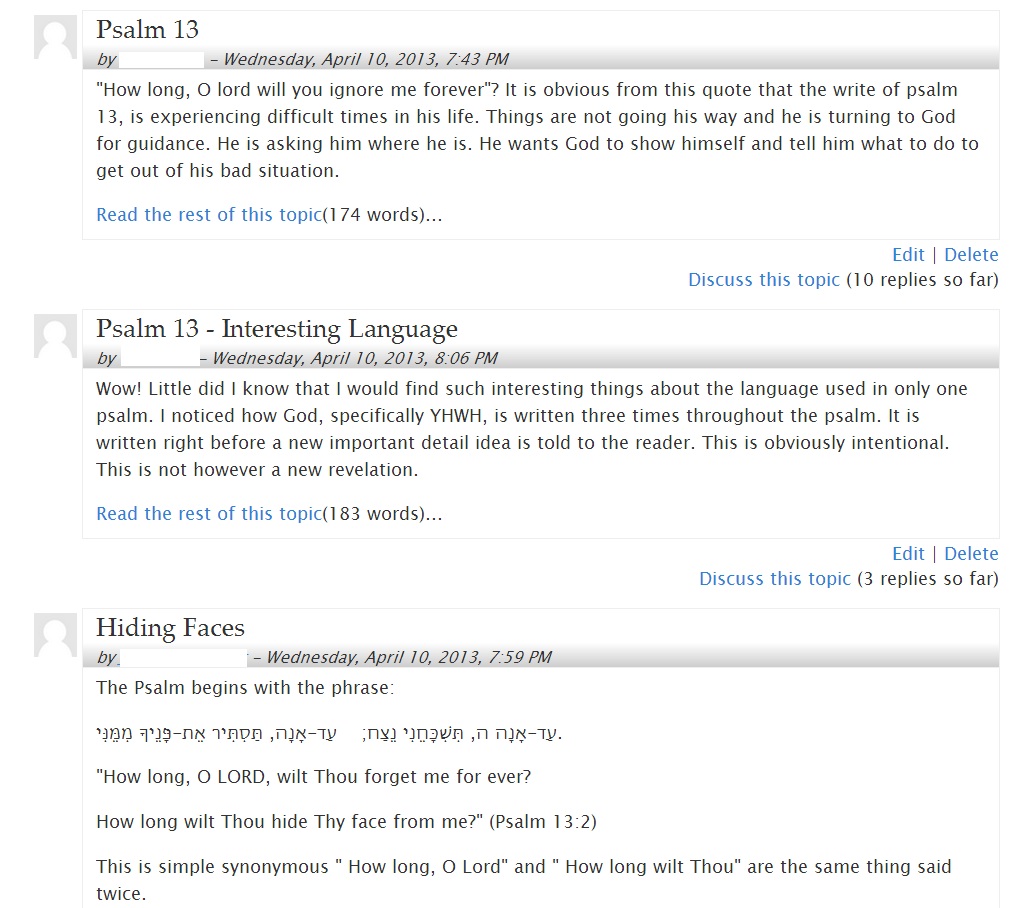
While we have primarily used Moodle this year as a tool for posting assignments, it has the potential to do so much more. 10th grade Tanakh teachers Becky Friedman-Charry and Esther Dubow have created a series of online forums in Moodle where 10th grade students in both sections of the course are extending their classroom conversations about various psalms. In a traditional classroom discussion only a limited number of voices are heard.  In the online discussion each student has the opportunity to share and be heard. Students are encouraged to post regularly and to read and comment on each other’s thoughts. Take a look at just a few of the postings about Psalm 13.


Student engagement in these discussion forums goes beyond their desire to be successful in a graded course.  They’re connecting to each other and they’re connecting to our Jewish tradition.
Social Studies teacher Kelly Delaire is similarly reaching out to her students through social media. As previously reported in Paw Print Now, Ms. Delaire realized that if she wanted her students to be more in touch with current events, she had to reach out to them where they were. On this Facebook page, news articles and essays are being posted that are relevant to her students’ studies and extending the learning outside of the classroom.

Each of these projects is an incredible way to make learning more meaningful and engaging. The assignments and information is interesting and allows the students to interact in a forum that they are comfortable with. They demonstrate our willingness to embrace a trend towards blended learning that combines online and traditional classroom interaction. But, perhaps, most importantly, they create opportunities for students to learn and model the online behaviors that we want them to present as they boldly venture out onto the Internet.

Friday, April 19, 2013

The School is Alive with the Sounds of Music...


It has been a week, well slightly more than a week, filled with music. It began last Friday with a walk through the birth of Hatikva by Astrith Baltsan, a renown Israeli concert pianist and scholar. Students were captivated as she told the story of a complex song that reflects the character of the country that it represents. It was an incredible preparation for our return to school this past Monday for Yom HaZikaron and Yom Ha’atzma’ut.

Each of these days was marked by music. On Yom HaZikaron, we sang with mourning and longing in our hearts for those who had given the ultimate sacrifice in defense of the state of Israel. Just as the mood shifted in Israel, so too here did our hearts lighten as we entered Yom Ha’atzma’ut. The senior class marked our celebrations by their incredible performance of the Prince of Egypt, completely in Hebrew. We wrapped up the day with songs of joy and hope.

Here is just a taste of the music that mirrored our emotions as we moved through the week.

Shabbat Shalom!

Thursday, April 18, 2013

PowerPoint: What's the Point?

In an era where we are supposed to be promoting the use of technology, I have to admit that there is one tech tool that I just see as overused and poorly applied. It's PowerPoint.

When I taught instructional technology at Temple University, I devoted a few lessons to the appropriate usage of PowerPoint. I covered things like appropriate contrast between background and text, how to appropriately insert graphics, and how to properly use the animation tools. I often shared some more horrendous slides, like these and these.

When using PowerPoint correctly, it can support creating an engaging presentation with visual supports for the spoken word. Most of the time, though, I see PowerPoint presentations crammed with too much information and presenters read the slides instead of using them as a place to provide us with visual cues for their talk.

It is cases like these that my mind travels back to the classic film strips that I remember teachers showing in classes when I was younger. I was always really excited when the film strips would come out. These presentations combined audio and visual media and generally drew you into the presentation in the same way that a good PowerPoint presentation should.

The key to the good use of PowerPoint really does not lie in the technical skills of arranging slides and using transitions. So much of that is bells and whistles that draws away from the presentation. The true mastery of PowerPoint lies in creating enough visual information to help engage your listeners in your oral presentation.

One of the best ways to do that is to create an infographic. Believe it or not, these visual presentations of data are often produced in PowerPoint. With an infographic behind you on the screen, suddenly, you are able to tell your story in much greater depth. Your audience can explore the visualization of the infographic as you share with them your interpretation of what they see. There are even handy templates for building these infographics, such as this one.

So, what are you waiting for? Switch out your standard PowerPoint presentations for PowerPoint infographics.

Monday, April 15, 2013

Confessions from a Former School Psychologist


It has been five years since I last touched a WISC kit or any other testing kit.

No, this is not my introduction to a school psychologists’ anonymous meeting, but rather a reflection on the biggest change that I have undergone since handing in my testing kits and becoming a school administrator.  Otherwise, so many of my skills and training as a school psychologist have transferred directly to my new role.

As a school psychologist, I was very fortunate. I worked in a school district that supported an excellent student to school psychologist ratio and our leadership in student services pushed us to support our students through more than just the refer-test-place process. I actively consulted with teachers, had ample time for counseling, and was heavily involved in the implementation of my schools’ positive behavior and intervention support (PBIS) programs. I helped develop student support teams in my schools while working to make sure that the more restrictive special education placements that I supported worked successfully. All of this existed in a collegial atmosphere of our psychological services office which encouraged us to grow and collaborate as practioners.

Somehow, in the midst of this, I came to a conclusion that I was feeling limited by my role. As I worked to support PBIS and other programs, I was restricted, not because of anyone’s conscious desire, but because as a school psychologist, I often functioned parallel to the educational system that I supported. While I could consult, advise, and plan, I was unable to supervise or mandate and certainly did not have direct access to a budget to support my efforts. Perhaps most importantly, I wanted to a have a different kind of impact on changing the school environment that I saw as a factor in my students’ difficulties.

It was at this point that I decided to pursue additional training as a school administrator. Since that initial certification as a school administrator, I have continuously marveled at the overlap between my two chosen fields. While I am now in a position to supervise teachers, I get my best results when I apply my skills as a teacher consultant. The line of students and teachers who just want a few moments to chat and get something off their chests has not change; I’m just in a different place to address them. Likewise, I still support our intervention teams as we work collaboratively to eliminate student problems.

There are differences, of course. As an administrator, I worry about the budget that I once longed for. Sometimes, what had been a supportive consultation with a teacher needs to move to being a directed conversation where my authority as the principal is used. Mundane issues, like the boiler or trash in the cafeteria, can fill my days and sometimes I feel a greater distance from the students that I went into both of my careers to help.

At the end of the day, though, I am grateful to have had the opportunity to have crossed the bridge between school psychologist and school administrator. Most of my colleagues in administration are former teachers. Very few share my background as a school psychologist. Yet, it is this background that I feel has made me a more effective instructional leader and helps me navigate the often murky waters of school administration.

Cross-posted at Musings of an Urban School Psychologist.

Friday, April 12, 2013

(Re)Designing Tefillah


A colleague of mine once referred to tefillah as the third rail of Jewish education. As irreverent as this may sound, it stemmed from a deep-seated concern that as Jewish educators we struggle with this area of the day school experience, not because it is not important, but because of its complexity and how hard it is to get it right.

Tefillah is hard. Even as adults we struggle with connecting with God during davening on a Shabbat morning. We try to find the right kavana (intent) to go with our keva (the fixed process of tefillah) and often miss the mark. I can only imagine what our synagogue rabbis are thinking as they stare at us from the bima while we are either grappling with this dilemma or are completely off task. Given how difficult meaningful, engaging tefillah is for adults, it is no wonder that adolescents also struggle with blending kavana and keva together in our daily minyanim.

With this problem in mind, we have begun a series of conversations at school to grapple with this challenge. Our Va’ad Tefillah (prayer committee) is a combined group of students and staff who are actively engaged in seeking solutions to this. The Va’ad Tefillah, with the support of The Jewish Education Project’s Day School Collaboration Network, has been using design thinking to address the often intractable problem of creating meaningful, relevant, and engaging tefillah experiences for our high school students. Through this design thinking process, we immersed ourselves in the situation by looking at it from our students’ points of view. We also sought inspiration from a variety of sources. With this in hand, we began to understand what tefillah experiences meant for them.

We then worked to frame our problem to create “how might we” statements that helped us better define the problems facing us in high school tefillah. We then imagined what could possibly be and collaborated to develop a series of prototypes to help us test our understanding, gain more information, and learn as we continued to work in the cycle of immerse, frame, imagine, and prototype.

Our initial prototypes were a series of alternative minyanim that allowed students to engage with tefillah in a different way. Here are the choices and descriptions that were available to students:

Regular Minyan: Similar to our daily minyanim, this larger group minyan will join together for a spirited davening.
Meditation Shacharit: How do I improve my focus, and organize my thoughts in tefillah?  Come to this Shacharit, where you will learn exciting ways to use meditation a mode of thinking to help you focus and direct your tefillot in new and exciting ways.
Words of Prayer: The siddur is an ancient combination of words from the Tanakh, with additions, adjustments and an overall organization made by our Rabbis through the generations. This minyan will take a close look at different prayers and we'll discuss how each prayer fits into the Rabbis' overall plan for the siddur, and how we can make sense of the siddur – personally -  as 21st century Jews.
Are You There God?: How can we discuss God? Why should we discuss God? What is God? How do we believe in God? (and what does that mean anyway!) This minyan will think about these questions and many other theological issues. Our goal is not to generate answers about God, but rather to startthe conversation about God.
Tech and Tefillah: Can the texts of the tefillot be communicated through modern means? How much of a tefillah would you tweet? We will explore using technology tools, like Twitter, PowerPoint, and Facebook, to help us gain greater understanding of the tefillot in the siddur.

Are these alternative minyanim the solution? Probably not alone, but they are a starting point. These experiences were followed up by a survey as we seek to design a better tefillah experience. Through this process, we hope to shift away from thinking about tefillah as an insurmountable challenge for the Jewish day school experience into one that adds meaning and relevance to all of those who participate.